The second careers of industrial automation are seldom credited. The neural networks that identify a crack in a hairline on a brake disc are now used to identify a cloned account on a gaming platform, and the anomaly models that listen to bearings also listen to betting patterns. Online casino security, which is scrutinized, appears like a factory that exports trust.
The production line starts earlier than most players realise. Platforms across Canada run that machinery from the first click: registration and sign in feed the models before anyone can play at RomiBet, the official website screens each login in milliseconds, and the Romi Bet online casino applies factory-grade checks so CA players meet the RomiBet casino lobby only after the algorithms do.
Machine Vision Learns to Watch the Tables
Vision systems are used on a production line to compare thousands of parts per hour with a golden sample. Live-dealer studios run the identical architecture: cameras track cards, chips and hands, flagging any frame that deviates from the expected sequence. A dealt hand is, to the network, another component that is going through the lens.
The parallel goes down to the hardware. The reason studios light inspection cells light components, high-frequency and shadow-free, is that both systems fail in the same manner when the image becomes noisy.
The common frontier is edge deployment. As inspection models are currently executed on cameras next to the line, rather than a remote server, studio analytics are more and more scored locally, eliminating the round-trip that fraud prefers to conceal in.
It is bound together by optical character recognition. The software that reads a serial number on a gearbox is a close relative to the software that reads a card index at a baccarat table.
Anomaly Detection: One Algorithm, Two Assembly Lines
Factories have predictive systems that learn the normal signature of a machine, such as vibration, temperature, current draw, and signal a hand when the signature changes. Fraud engines are trained on a normal signature of a player: length of session, rhythm of stake, cadence of deposits, device fingerprint. They are both time-series problems in different uniforms.
Drift is a different thing in every hall, but the mathematics is common. A bearing that is running hot and an account that suddenly bets at 4 a.m. in a new country are, to the model, the same event: a distribution that ceased to fit its history.
Bot detection is a borrowing of robotics twice. Robotic motion on a factory floor is now recognised by systems that have been trained to recognise robotic clicking in a lobby, patterns that are too regular to be human. The irony hits home on a robotics blog: machines that are created to hunt machines.
KYC Robots on the Onboarding Line
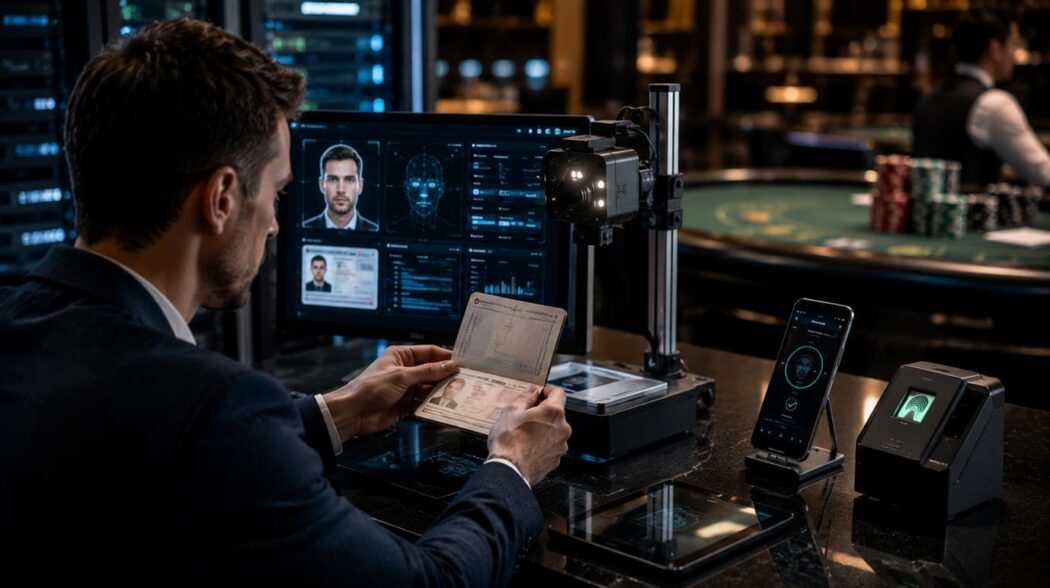
Identity checks used to be a clerk’s job; now they are a pipeline. Document classifiers, liveness detectors and sanctions-screening services operate in a series like stations on a conveyor, with each station passing or rejecting the unit before it. The reject rate is maintained in each station and quality teams adjust thresholds as process engineers adjust tolerances.
Canadian operators show the pipeline at full speed. In Canada, document checks start at registration: the SlotLair casino page routes each file to machine verifiers, the official website matches selfie to ID before sign in, and every later login lets the Slot Lair online casino confirm the SlotLair casino account still belongs to its CA owner.
The automation is explained by the throughput numbers. A verification queue that used to take days to clear is cleared in minutes, and the rejects are sent to human inspection just as flagged parts are sent to a rework bench.
Predictive Maintenance for Platforms
Uptime is a security aspect, and platforms are disciplined about it like a plant manager. Load balancers, failover clusters and synthetic monitoring are the spare pumps and standby generators that ensure the line continues to run when a component fails. A Saturday night downtime costs a platform what an unplanned stop costs a smelter.
The maintenance culture is applied to the models. The classifiers of fraud are weakened by the adaptation of attackers, and thus the teams plan retraining similarly to how engineers plan lubrication, not on calendar estimates, but on data-driven intervals.
Even incident response is written like a factory manual. Runbooks, root-cause analysis, and blameless post-mortems all originated in heavy industry and aviation, and became trendy in software.
Behavioural Telemetry and Safer Play
The latest transfer is the most human. The player fatigue is being targeted by the telemetry that forecasts component fatigue, and models are monitoring loss-chasing, growing deposits and sessions that are beyond their normal pattern. They are referred to as markers of harm in the research literature; an engineer would refer to them as fault codes.
Canadian regulators are increasingly requiring operators to show such monitoring instead of simply promising it, which shifted telemetry to a nice-to-have to a compliance line item.
Responsible-play models close the loop for CA users: after registration, the official website tracks session tempo, a hesitant sign in pattern can trigger a cooldown prompt, and players who log in to RioAce see limits surfaced by the same telemetry the Rio Ace online casino uses across Canada — each login teaching the RioAce casino systems what healthy play looks like. Safety engineering, in other words, finally covers the person as well as the machine.
From Factory Floor to Casino Floor
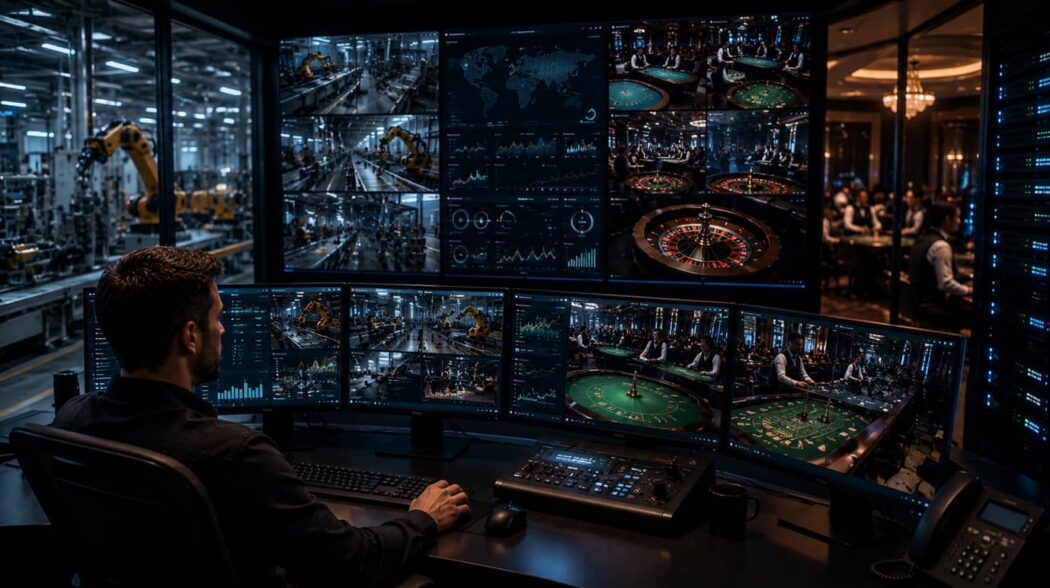
The family is not poetic but direct. Convolutional networks were developed to handle visual inspection problems, reinforcement learning was developed to work in robotics laboratories, and gradient-boosted models were developed to score credit risk. All three were handed over to gaming operators as completed tools.
The textbook history explains the transfer. As Wikipedia’s article on machine learning outlines, the field advanced by generalising: a model that classifies defective castings differs from a fraud classifier mainly in its training data. Industry supplied the data first, so industry debugged the methods first.
Talent followed with the instruments. Recruiting pages on either side now demand the same structures, the same sensor experience and the same model-monitoring practices.
Casinos on land were pioneers in industrial adoption. Their camera rooms hosted some of the earliest commercial facial-recognition and pattern-tracking systems, long before those terms became commonplace. Surveillance rooms were, practically, carpeted machine-vision laboratories.